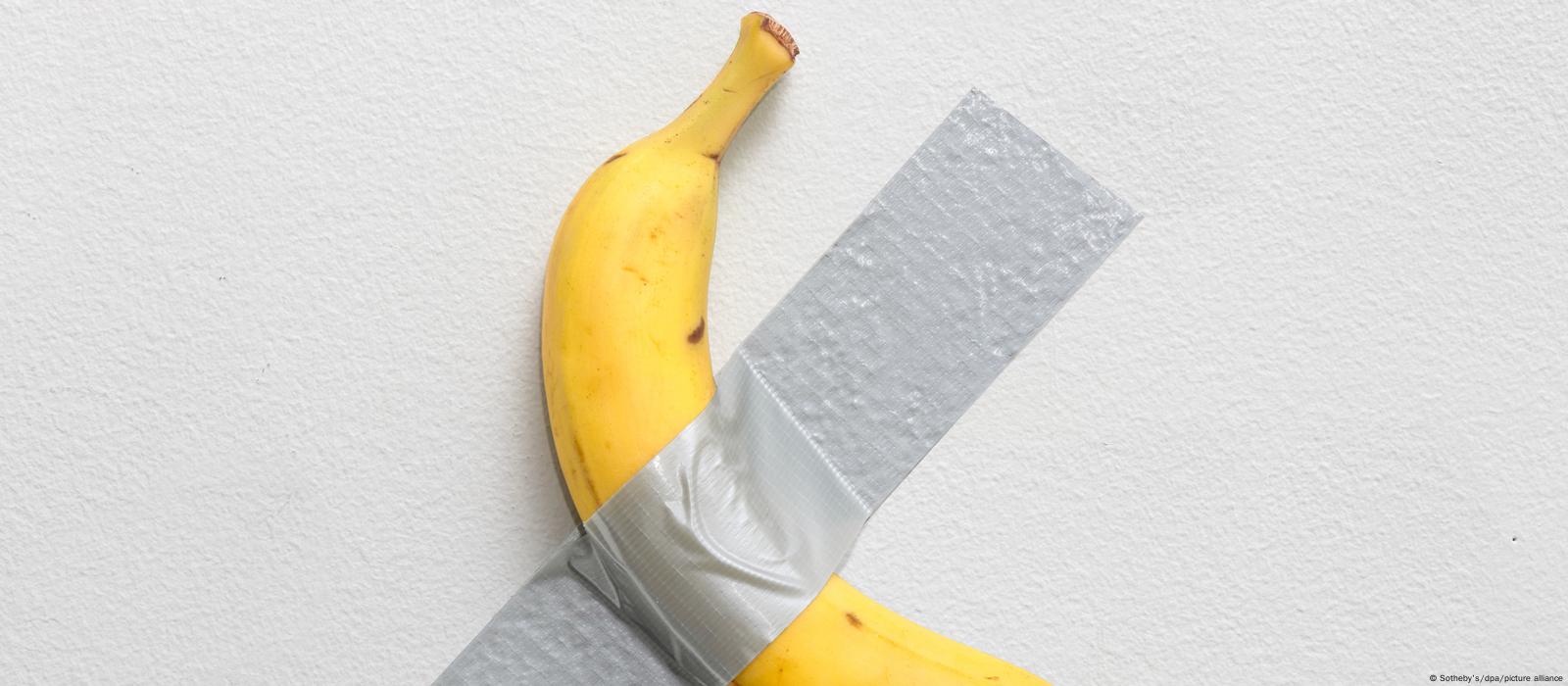
Conceptual art often teeters precariously between challenging viewers and verging on the ridiculous. Few artworks capture this dynamic as strikingly as Maurizio Cattelan’s “Comedian” — essentially a banana affixed to a wall with duct tape, which was first displayed at Art Basel Miami Beach in 2019. This creation swiftly evolved into a cultural phenomenon, igniting endless debates concerning the essence of art, the worth we attribute to items, and the significance of performance in modern galleries. However, “Comedian” has recently regained attention for a reason just as bold as the artwork itself: someone has consumed it. Once more.
The banana, originally sold for $120,000, is known not so much for the fruit itself as for what it represents — a statement on commerce, value, and perhaps the commodification of creativity. The real work, according to the artist, is not the banana but the certificate of authenticity and the concept behind it. Owners of “Comedian” are instructed to replace the fruit periodically, acknowledging its impermanence and positioning the act of decay as part of the work.
But when visitors consume the art — literally — they take the ephemeral nature of the piece to a new level.
The recent event took place in an exhibition area where “Comedian” was showcased, attached to a plain wall with silver duct tape, as initially designed. An attendee, described as a student, walked up to the artwork and casually removed and consumed the banana before the astonished observers. The whole episode was recorded on video, rapidly spreading across the internet and sparking renewed discussions about artistic expression, purpose, and ownership.
Interestingly, this is not the first instance of Cattelan’s banana being eaten. When it debuted at Art Basel, a performance artist by the name of David Datuna attracted attention by consuming the piece before an audience, labeling his act as an “art performance” and expressing admiration for Cattelan’s creation. Although there was some initial bewilderment and questions about security, Cattelan’s crew quickly replaced the banana. No legal steps were pursued — and in several ways, Datuna’s actions contributed to the lore around the artwork.
The recurrence of this action says a lot about the characteristics of conceptual art in the era of social platforms. Does consuming the banana act as a self-referential critique of the initial piece? Or is it just a stunt aimed at capturing attention, made possible by the widespread nature of online culture?
Cattelan himself is no stranger to artistic controversy. Known for his provocative installations — including a solid gold toilet titled “America” and a wax sculpture of Pope John Paul II struck by a meteorite — the Italian artist frequently blurs the lines between satire and seriousness, forcing audiences to confront their own expectations of art.
With “Comedian,” the banana becomes a mirror, reflecting back society’s fascination with spectacle, value, and disruption. Whether duct-taped to a wall or digested by a performance-hungry audience member, the banana resists permanence, acting instead as a symbol of impermanence and absurdity.
Critics of conceptual art often argue that pieces like “Comedian” lack depth, relying on shock value rather than technique. But defenders note that the reaction it evokes — from think pieces in major newspapers to performance interventions — is evidence of its impact. Art, after all, doesn’t exist in a vacuum. Its meaning is shaped by context, interpretation, and public discourse.
From a legal standpoint, the situation is more complex than it appears. Although the banana is replaceable, eating the fruit could still be considered destruction of property or violation of gallery rules. However, institutions and collectors involved with Cattelan’s work are well aware of its inherently performative nature. They are typically more concerned with preserving the idea and its documentation than the physical banana itself.
This raises important questions about the boundaries of participation in art. If an artwork invites engagement, where is the line between interaction and intrusion? Can an unsanctioned performance become part of the artwork’s evolution? And perhaps most intriguingly: who owns the story that unfolds when an audience member intervenes?
In today’s world dominated by digital content, art images are quickly spread and readily consumed, making the tangible piece of art almost take a back seat to its online portrayal. “Comedian” fits perfectly within this culture — an uncomplicated, nearly ludicrous image that proliferates more swiftly than the majority of great works. The banana attached to a wall is instantly turned into a meme, extraordinarily absurd, and ideally aligned with an internet-focused cultural period.
However, as some find it amusing, others perceive the piece as a commentary on the structure it thrives in. By vending a banana with a hefty price tag, Cattelan highlights the inconsistencies present in the art community — illustrating how worth can be separated from substance and how business and artistry frequently meet in disconcerting ways.
Whether one sees the banana as a masterpiece or a media stunt, its staying power — both in cultural discourse and repeated performances — is undeniable. Every time someone eats it, they breathe new life into the piece, perhaps even enhancing its legacy. In a world where attention is currency, and where meaning is increasingly collaborative, “Comedian” continues to ripen.
So when another banana is inevitably taped to another wall, somewhere in a white-walled gallery, we may all wonder: is this the original joke, a new chapter, or just another bite in the ongoing conversation about what art really is?


:max_bytes(150000):strip_icc()/VWH-GettyImages-2168531818-3e0c9a6c46fe445ab049a4daf639baa5.jpg "How To Incorporate Glycolic Acid Into Your Skincare Routine, According To The Experts")