

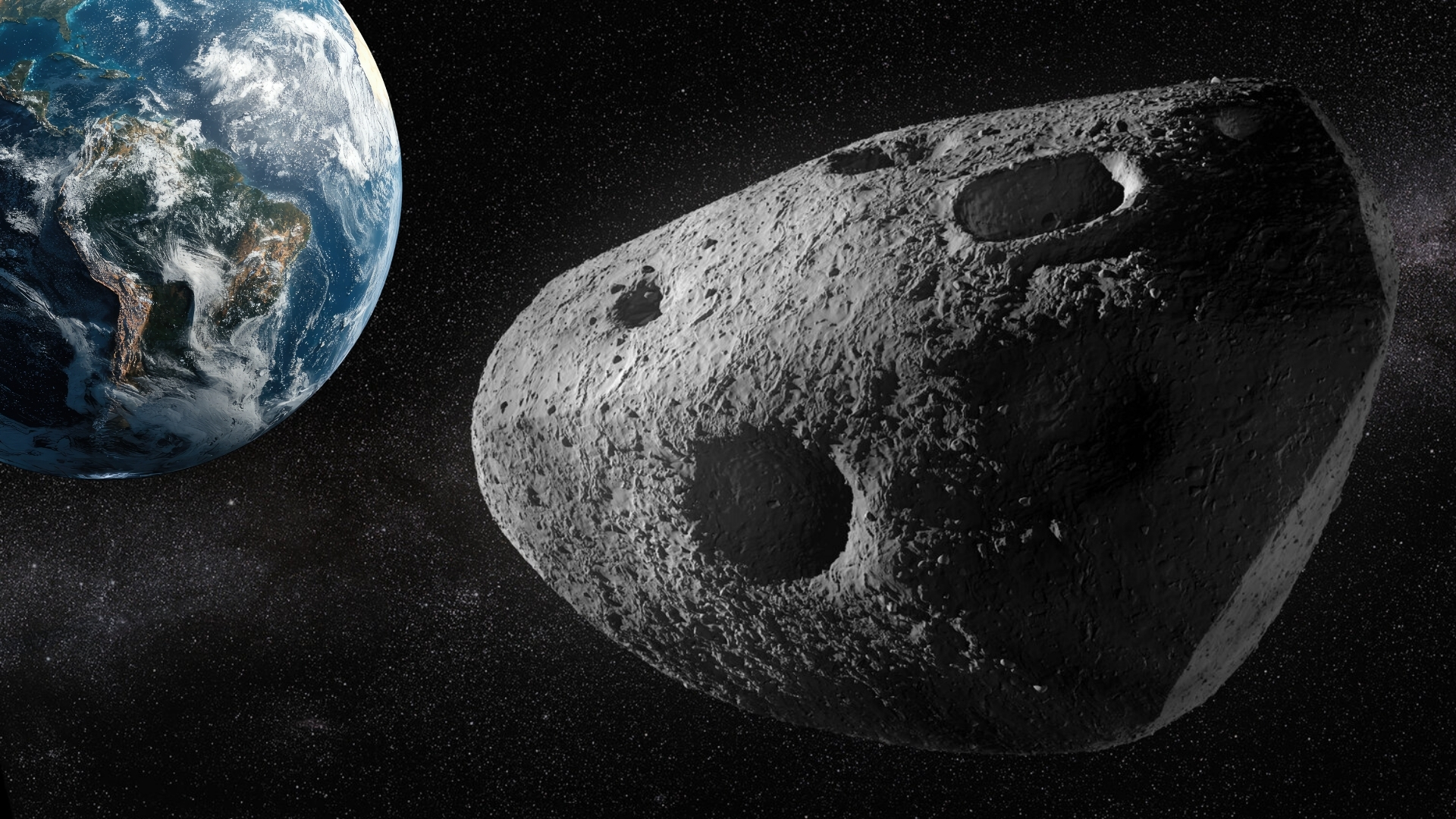
A recently detected asteroid will pass relatively close to Earth this Monday, attracting the interest of astronomers and space agencies worldwide. Even with the narrow cosmic distance, experts stress that the object poses no risk to the planet and will proceed safely along its trajectory through space.
Astronomers are closely monitoring an asteroid known as 2026JH2, a rocky object expected to glide past Earth at an estimated distance of about 91,593 kilometers, roughly 56,900 miles. According to calculations from the European Space Agency, its trajectory will bring it to nearly one quarter of the usual gap between Earth and the moon, placing it among this year’s closest recorded asteroid flybys. Even so, researchers point out that it presents no risk of impact or atmospheric entry.
The asteroid was first observed on May 10 by researchers with the Mount Lemmon Survey in Tucson, Arizona, one of several programs dedicated to monitoring near-Earth objects, and once detected, it received the official designation 2026JH2 and was classified as part of the Apollo asteroid group, noted for having orbits that intersect Earth’s trajectory around the sun.
NASA’s Jet Propulsion Laboratory estimates that the asteroid will make its closest pass shortly before 6 p.m. Eastern Time. While that distance may appear alarmingly close from a human perspective, astronomers note that such flybys are relatively common within the broader scale of the solar system.
Why experts believe there is nothing to worry about
Planetary scientists have reassured the public that the asteroid presents no threat to Earth, pointing out that it will make a safe flyby. Richard Binzel, a professor at the Massachusetts Institute of Technology and the creator of the Torino Scale used to classify asteroid impact risks, noted that objects of similar size frequently move between Earth and the moon without causing any issues.
According to Binzel, asteroids comparable in size to a car or small bus routinely travel through Earth’s cosmic neighborhood. The main difference today is that advances in detection technology now allow astronomers to observe many of these objects that previously would have gone unnoticed.
At its nearest approach, 2026JH2 will still lie far beyond the orbital heights used by numerous geosynchronous satellites that enable telecommunications, weather prediction, and broadcasting, and researchers emphasize that the object’s path has been carefully evaluated and does not cross Earth’s trajectory.
Experts believe the asteroid originated in the main asteroid belt between Mars and Jupiter, a region where collisions among rocky objects and Jupiter’s gravitational influence have long been known to push fragments inward, sending material into the inner solar system and giving rise to many of the near-Earth asteroids that astronomers track today.
Although the current flyby is harmless, the event highlights the importance of continuous observation programs designed to identify potentially hazardous objects before they become a concern.
The challenge of determining an asteroid’s exact size
Despite direct observations of 2026JH2, astronomers remain unable to pin down its exact size, with current scientific assessments placing its diameter somewhere between 15 and 30 meters, a range comparable to one or two school buses, yet this approximation stays ambiguous because telescopes that operate in visible light only register the object’s brightness.
Patrick Michel, an astrophysicist and research director at France’s National Centre for Scientific Research, explained that an asteroid’s brightness does not directly reveal its size. A darker object may appear faint even if it is relatively large, while a smaller but highly reflective asteroid could seem brighter.
Astronomers can more precisely determine an object’s dimensions when they obtain infrared data, since this kind of observation captures heat signatures that correlate closely with an object’s actual size. Yet conducting infrared studies from Earth is considerably more challenging, so such measurements are usually absent during the initial detection of near‑Earth objects.
Scientists compare the lower end of 2026JH2’s estimated size range to the meteor that exploded over Chelyabinsk, Russia, in 2013. That event generated a shockwave that shattered windows and injured more than 1,000 people. At the higher end of the estimate, the asteroid could resemble the object associated with the 1908 Tunguska event in Siberia, which flattened vast areas of forest.
Researchers emphasize, however, that those comparisons are purely related to size and not to danger. Unlike those historic incidents, 2026JH2 will not enter Earth’s atmosphere. Its path keeps it safely distant from the planet, eliminating the possibility of an atmospheric explosion or surface impact.
Monitoring asteroids in the coming years remains crucial
Scientists remain confident that 2026JH2 currently poses no danger, yet experts admit that forecasting an asteroid’s long-term trajectory is inherently difficult, as orbital routes can shift over the years through gravitational pulls from planets and other cosmic objects.
Michel noted that while long-term paths can never be forecast with perfect accuracy, current assessments show that no identified asteroid is expected to pose a significant collision risk in the next century, and planetary defense teams continually monitor thousands of near-Earth objects to detect any possible changes in their trajectories.
The close flyby comes at a moment when planetary radar resources are far more constrained than in earlier years. Jean-Luc Margot, a professor of planetary sciences at the University of California, Los Angeles, noted that the 2020 collapse of the Arecibo Observatory sharply curtailed the scientific community’s radar observation capabilities. Moreover, NASA’s Goldstone radar facility is presently undergoing extensive repairs.
Without radar data, astronomers face greater challenges in pinpointing the exact shape, rotation, and trajectory of nearby asteroids, and although optical telescopes provide valuable information, radar instruments allow scientists to develop far more precise representations of an object’s movement and physical properties.
Margot noted that astronomers have detected only a limited number of near-Earth asteroids comparable in size to 2026JH2. Since many of these bodies are quite dim and compact, they typically come to light just days before their closest flybys, becoming visible only when their brightness finally reaches the threshold of survey telescopes.
Space agencies and scientific organizations, compelled by this limitation, have expanded their funding for asteroid detection and tracking programs, and upcoming observatories together with more sophisticated sky surveys are expected to significantly elevate discovery rates in the next few years, giving researchers the means to assemble a far more thorough inventory of nearby objects.
A remarkable celestial spectacle is expected to unfold with the approach of Apophis
As 2026JH2 draws increasing attention for its close flyby, astronomers are already shifting their gaze toward an even more remarkable occurrence expected in 2029, when a significantly larger asteroid named Apophis is predicted to pass Earth at an even nearer distance on April 13 of that year.
Scientists estimate that Apophis will pass roughly 32,000 kilometers from Earth, placing it closer than some satellites that circle the planet, and although this approach is remarkably near, astronomers stress that it presents no threat and regard it instead as an exceptional scientific opportunity.
The anticipated Apophis flyby is positioned to become one of the most closely monitored asteroid encounters of modern times, and unlike 2026JH2, which will remain out of sight to the naked eye, Apophis is expected to be visible without telescopes from several regions across Europe, Africa, and the Middle East.
Events like these offer researchers valuable opportunities to study asteroid composition, movement, and structure while refining planetary defense strategies. Each close approach improves scientific understanding of how these objects behave and how humanity could respond if a future asteroid ever posed a genuine threat.
For now, astronomers explain that the arrival of 2026JH2 chiefly underscores the constant shifts in Earth’s cosmic surroundings, where small asteroids routinely move through the solar system, and advancing technology enables scientists to spot them well before any close encounter occurs.
A live broadcast of the asteroid’s approach is set to stream through the Virtual Telescope Project from its observatories in Italy, offering astronomy enthusiasts around the world a real-time view of the event as it happens. Although the asteroid will remain far too dim for most people to detect unaided, its nearby transit continues to fuel widespread curiosity about the countless bodies silently traveling through the expanse of space surrounding Earth.


